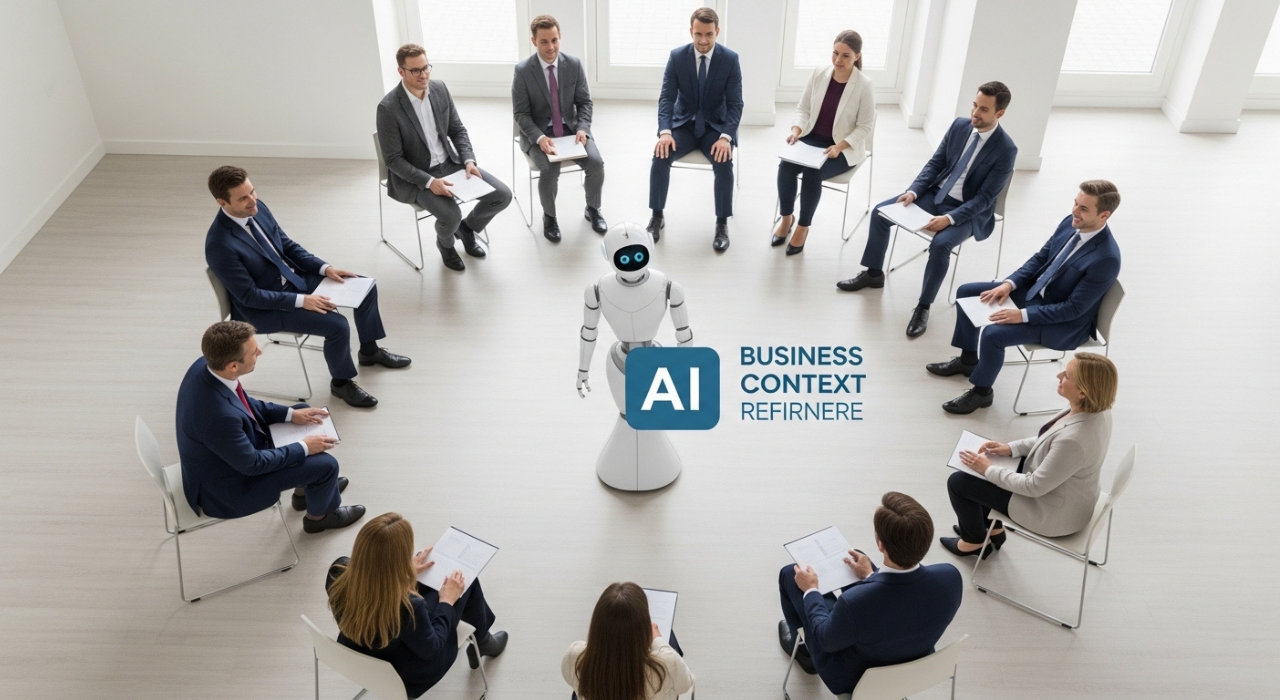
AI business context refinement is the process of tailoring artificial intelligence systems so they deeply understand your company’s unique language, data, workflows, goals, and decision logic — not just generic patterns — enabling AI to deliver relevant, accurate, and high‑value outcomes from day one. In practical terms, context refinement connects AI to your business history, terminology, rules, and strategic priorities, so the outputs aren’t just technically correct but directly useful in real‑world work scenarios.
What Is AI Business Context Refinement?
At its core, AI business context refinement refers to adapting generic AI models — like large language models (LLMs) — to a company’s specific operational realities. Generic AI can generate broad results but often lacks understanding of industry‑specific knowledge, internal terminology, business policies, or compliance needs. Refinement bridges that gap by grounding a model’s outputs in structured knowledge and real data from the business itself.
This process often involves:
• Fine‑tuning on internal or domain‑specific datasets
• Incorporating real‑time knowledge retrieval systems (e.g., Retrieval‑Augmented Generation or RAG)
• Embedding governance and compliance policies
• Integrating AI with operational systems like CRM, ERP, and internal knowledge bases
By doing so, context becomes not just static information but usable intelligence that amplifies accuracy, relevance, and trust in AI outputs.
Key Functions and Techniques
Here are the main methods used to achieve effective AI business context refinement —
1. Domain‑Specific Fine‑Tuning
Training a base AI model on business‑specific datasets — such as customer interactions, product knowledge, or internal documents — teaches the model the company’s vocabulary, norms, and decision logic. This elevates performance far above what generic models deliver.
2. Prompt Engineering & Context Templates
Where training isn’t feasible, advanced prompts with structured guidelines and business rules ensure the AI interprets user inputs correctly and aligns outputs with business logic.
3. Retrieval‑Augmented Generation (RAG)
RAG lets the system fetch relevant documents, policies, or customer history in real time before generating responses, anchoring outputs in the most current and accurate information.
4. Dynamic Context Layers
Platforms that build a “context layer” ingest semantic relationships, business glossaries, and rule sets from across the enterprise. Some tools automate the generation of business metadata, creating a ready‑to‑use semantic foundation for AI systems with minimal manual work.
5. Human‑in‑the‑Loop Refinement
Feedback loops where human domain experts correct, validate, and refine AI outputs improve accuracy over time — especially for high‑stakes business decisions.
Why Context Matters in Business AI
Without proper context, AI can misinterpret signals, ignore key constraints, or generate outputs that don’t reflect business realities. Poorly contextualized AI often produces generic or erroneous results — a key reason why many AI pilots fail to scale or deliver real ROI.
Conversely, models grounded in a rich business context can:
✅ Improve decision‑making quality
✅ Speed up workflows
✅ Ensure compliance with internal policies
✅ Reduce errors and hallucinations
✅ Boost adoption and trust across teams
✅ Provide competitive advantage with faster insights
Companies that centralize and structure their enterprise data into contextual models enjoy better alignment between AI outputs and business strategies.
Latest Trends & Enterprise Adoption
Recent business thought leaders emphasize context engineering — the discipline of designing the environment in which AI operates — as the next frontier beyond prompt engineering. Context‑aware systems increasingly integrate multiple sources of truth (like data platforms, knowledge graphs, and policy engines) to support enterprise‑grade decision support systems.
Industry leaders are also extending context refinement into governance frameworks to ensure AI adheres to compliance, regulatory, and ethical standards — dynamically updating AI behavior without ongoing retraining.
Conclusion
AI business context refinement is no longer optional for serious enterprise AI — it’s foundational. By embedding context into AI systems, businesses unlock more accurate, reliable, and actionable insights tailored to their unique operations. With techniques like domain fine‑tuning, RAG integration, dynamic context layers, and human feedback loops, organizations can convert AI from a generic tool into a strategic partner that drives measurable business value and competitive advantage.